About Climate Change
The Intergovernmental Panel on Climate Change has stated the the “Scientific evidence for warming of the climate system is unequivocal.” NASA’s tracking of the vital signs of the planet shows rising sea levels, global temperature rise, warming oceans, shrinking ice sheets, declining arctic sea ice, glacial retreat, increasing extreme events, ocean acidification and decreased snow cover. Despite all the data, how climate change will play out in terms of its impact on our daily lives is subject to intense debate.
Two areas with potentially large impacts on business though are becoming clearer, and more frightening: the increasing incidence of billion-dollar weather and climate disasters, and a growing concern for the sufficiency of water supply, particularly in some large cities.
Data from the National Oceanic and Atmospheric Administration’s National Centers for Environmental Information shows that during the 1980’s there were 27 weather and climate events that did more than $1 billion in damage in the U.S. During the 1990’s there were 48 such events. In the 2000’s this rose to 54 events. Even now, only partly through the decade of the 2010’s, there have been 74 billion-dollar weather and climate disasters through the end of 2016.
According to the United Nations, while today round 700 million people suffer from water scarcity, by 2025, 1.8 billion people will be living in countries or regions with absolute water scarcity, and two-thirds of the world’s population may be living in water stressed conditions. As an essential need for life, the primacy of water scarcity rises quickly to the top of the agenda for an ever increasing number of countries, regions, and cities.
Business Challenges
Climate change has the potential to be the most devastating of the megatrends as it may profoundly impact the ability to sustain life itself in some areas. Even without such a drastic outcome, we are already seeing tremendous impacts of climate change in the dramatic increase in billion-dollar weather events and increasing water scarcity in major cities such as Beijing. Water scarcity has the potential to disrupt supply chains in many industries, requiring adaptation of business processes, a reassessment of the value chain and increased risk in the supply chain. Severe weather events also have the potential for severe short-term disruptions not only to businesses located in the affected areas, but also to supply chains and transportation and logistics systems.
Preparing for the unpredictability of severe weather events is particularly challenging for businesses, but the increasing incidence of these events means that businesses must develop emergency plans for events that severely impact their business, employees, customers and suppliers.
Trend Overview
Climate Change has a great impact on the eco-environment, which potentially affect people’s life and industrial behaviors. It is dependent on the choice of future economic and social development pathways. To be more specific, social development can be a strong determinant of vulnerability to climate change and vice versa. Most impacts of climate change cannot be avoided over the next few decades. The following indicators remind governments and companies the hidden danger of geographic change and production.
Global climate is changing and this change is apparent across a wide range of observations. The global warming of the past 50 years is primarily due to human activities. Global climate is projected to continue to change over this century and beyond. The magnitude of climate change beyond the next few decades depends primarily on the amount of heat-trapping gases emitted globally, and how sensitive the Earth’s climate is to those emissions. Meanwhile, billion dollar events resulted in the deaths of 188 people in 2020 so far and had significant economic effects on the areas impacted.
Table of Contents
Green House Gas Emission (GHG Emission)
In some content, five indicators are connected to each other. The first variable is the base of climate change. All the following changes are driven by the green house gas emission. Global Warming, which caused by the GHG emission, is also one of the most obvious and serious phenomenon in the society. Industries should reconsider the production target and environmental protection standard by linking to the renewable energy. Also, the governments might alter or attach more importance to the gas emission restriction.

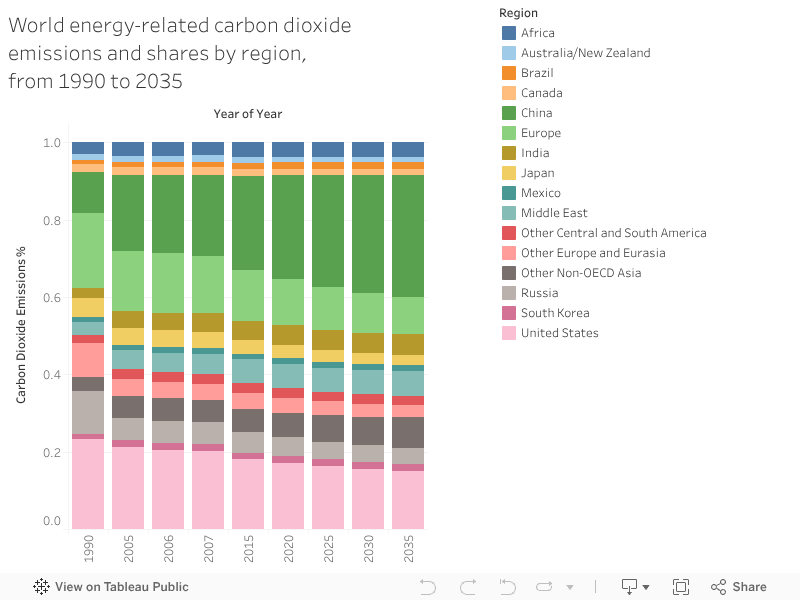
Green house gas emissions are fundamental element of climate change. In all green house gases, carbon dioxide has great impact on our environment and even people’s life. The carbon dioxide emission has an increasing trend in recent years, which partially causes the rising temperature and global warming. In these graphs, different areas and sources contribute to the carbon dioxide emission in considerable levels.

Find more statistics at Statista
Increasing CO2 amount influence the frequency and fluctuation of anomalies in land and ocean temperature. The following graph shows the difference from an average temperature, which indicates a growing trend in the past 100 years globally.

CO2 emission create great impact on the voluntary carbon offset markets. This voluntary market has prompted project developers to create technological innovations to reduce greenhouse gas emissions.
Rising Sea Level
Climate Change impact is mainly divided in two aspects- rising temperature and unstable rainfall. The second indicator – rising sea level- reflects the effect of temperature ascent. The result suggests the international communities to seriously consider the implications of sea level rising for the population location and infrastructure planning, and encourage coastal governments to plan to adaptation as soon as possible.


Sea level rising is a serious global threat nowadays. According to the World Bank, scientific evidence shows that due to the global warming, sea level will rise between 1 to 3 meters in this century. Here is the trend of mean sea level change worldwide from 5 database, and the sea height variation from NASA.


However, both the size of Arctic sea ice and Antarctica ice sheets continuously decreasing nowadays. Because of the unexpectedly rapid breakup of Ice Sheets, the sea level might meet a 5 meters rise.

5 scenarios are established to analyze impact of rising sea level. They are 1 to 5 meters increase in the height of sea level. And those 5 scenarios are analyzed in 84 developing countries.
Population and land face high danger of being replaced and submerged as sea level rising.

Besides, since continuously rising sea level will spark off many weather catastrophe, such as flood, the economic damage will become severe in the future if more and more ice sheets melt.
Water Stress
The Fourth indicator – water stress- reflects the effect of unstable rainfall. The water variability will has negative influence on domesticity, agriculture, and industry if people do not begin to notice the problem.


One of the main global differences in human health and food production stems from the geographical distribution of water availability. Over the decades, water availability has changed regionally, with apparent indications of stress in southern Europe, western Asia, and northern Africa. If these projected levels of water stress should continue the domestic, agricultural, and industrial sectors of these regions will be severely affected and lead to a possible decrease in development and growth.
These graphs show the average exposure of water users in each country to water stress, which essentially refers to the ratio of total withdrawals to total renewable supply in a given area. A darker shade means that more water users are competing for limited supplies.
Deforestation
The Third indicator – deforestation- partially lead to the increasing seriousness of global warming and unstable rainfall. This indicator generally remind the paper and box industry, who focus on deforestation for production, to constrain their target amount. It also encourage the development of renewable energy and energy production.


Deforestation is a serious problem in the past, and it has gained the control in the recent years. But, the forest areas are still decreasing now.

Nevertheless, the production capacity of paper, paperboard, and boxboard industry is increasing now, which might leads to heavy deforestation. Consequently, those markets might face the problem of missing resource in the future. Thus, those industries should began to consider alternative ways of developing their product, such as excavating useful and renewable resource.
With heavy deforestation in the world, the renewable energy and its renewability will shrink. This might have a deep relationship with the Energy topic. Also, the rainfall will be affected by the deforestation especially in the tropical area. This might related to the water stress.
Natural Disasters
The final indicator- natural disaster- correlates to all indicators above. The more and more intense natural events, most importantly, increase economic damages.


Floods, landslides, and all other extreme weather events that can have large impacts, are likely to become more frequent and widespread in the future and, in some cases, more intense. In general, the related impacts are expected to be broadly negative, including reduced water availability, damage to crops and most importantly, an exponential increase in economic damages.